
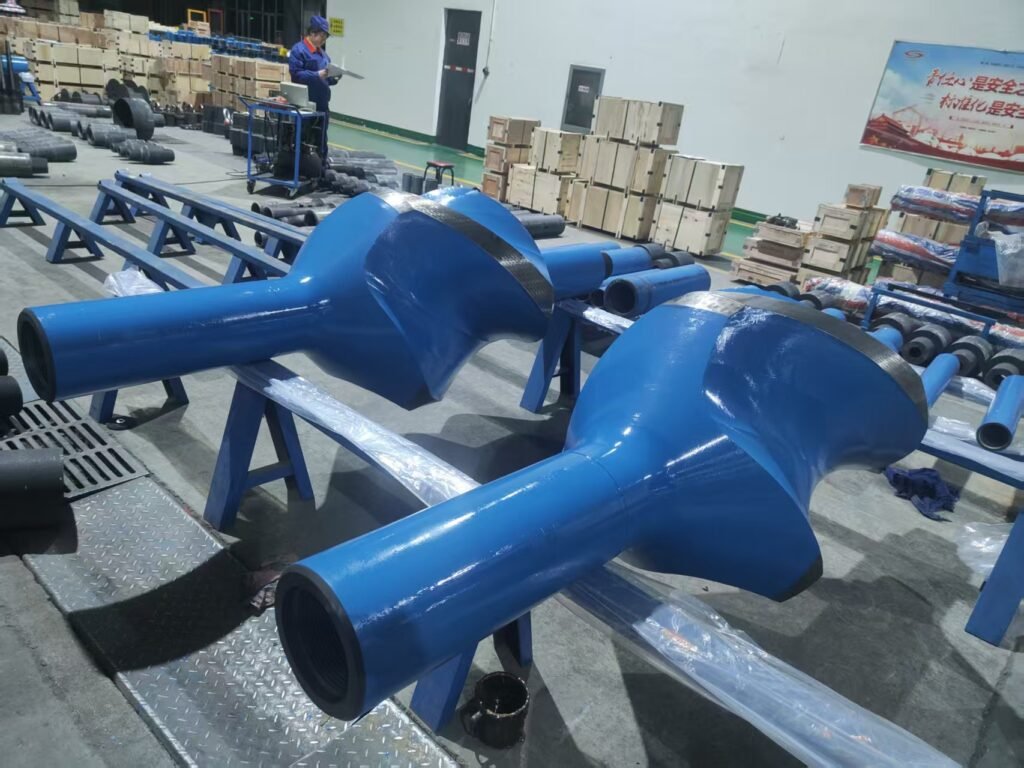
A stabilizer is one of the simplest tools in a drilling assembly — and one of the most useful. It is a short, heavy-walled sub whose blades stand proud of the body and ride against the borehole wall. By keeping the string centred, it helps the bit drill a straighter hole, reduces vibration, and keeps the rest of the assembly running true. This guide explains the two common blade types and what to send when you order one. See our stabilizer range for the types we supply.
What a Stabilizer Does
A drill string is long and flexible, and without support it can wander, vibrate, and wear unevenly against the hole. A stabilizer’s blades act as the contact points between the string and the borehole wall. Placed near the bit and at intervals up the bottom hole assembly, stabilizers keep the assembly centred in the hole so the bit cuts on line, reduce lateral vibration and whirl, which protects tool joints and connections, spread wear across the blades instead of the pipe body, and help control deviation in directional and vertical holes. In short, the stabilizer does not drill the hole — it keeps the tools that do drill the hole where they belong.
Spiral Blade vs. Integral Blade
The two terms describe different things: the blade pattern, and how the blades are made. Spiral blade stabilizers have blades that wind around the body in a helix. The spiral gives near-continuous contact with the wall as the string rotates, and the angled blades help drilling fluid and cuttings move past the tool. Integral blade stabilizers are forged as one piece, blades and body together, with no welds holding the blades on. The blue stabilizers in the photo above are integral spiral blade stabilizers — the blades are part of the body itself, cut in a spiral pattern. Straight blade stabilizers are the third common pattern: the blades run parallel to the tool axis. They are simple and effective where the hole is already close to gauge. Which pattern suits a job depends on the hole condition and the drilling program. If you are unsure, send the hole size and a short description of the application, and we can discuss the options.
Where Stabilizers Are Used
Stabilizers are normally run in the bottom hole assembly, close to the bit and at one or two points further up the string. They are also used in workover and reaming assemblies where a centred string matters. Because the blades are the wearing part, the blade diameter is matched to the hole size — too small and the tool cannot centralise the string, too large and it will not pass through the hole. That is why the hole size, not the pipe size alone, is the first detail to confirm. Stabilizers run alongside casing and the rest of the string, so the connections at each end must match the tools above and below.
How to Order a Stabilizer
To quote a stabilizer we need four details: (1) hole size — the diameter the blades must match; (2) connections — pin and box at each end, with the thread type (NU, EU, BTC, STC, LTC, LP/NPT, premium thread, or ST-ACME); (3) body material — stabilizers are machined from alloy steel such as 4140 and 4145, so tell us the grade if your program specifies one; (4) blade pattern — spiral, straight, or integral blade. Our integral spiral blade stabilizers are made to the hole size, in the 6″–26″ range, and we confirm the drawing with the customer before machining. All threads are machined in our Tianjin factory, which works to API Spec 5CT / 5B, and premium thread connections can be supplied where the string calls for them. Third-party inspection can be arranged on request. Our factory is in Dagang, Binhai New Area, Tianjin, near Tianjin Port.
For a quote, send the hole size, connection details, and blade pattern to info@lxoctg.com or WhatsApp +86 182 2292 5608.