
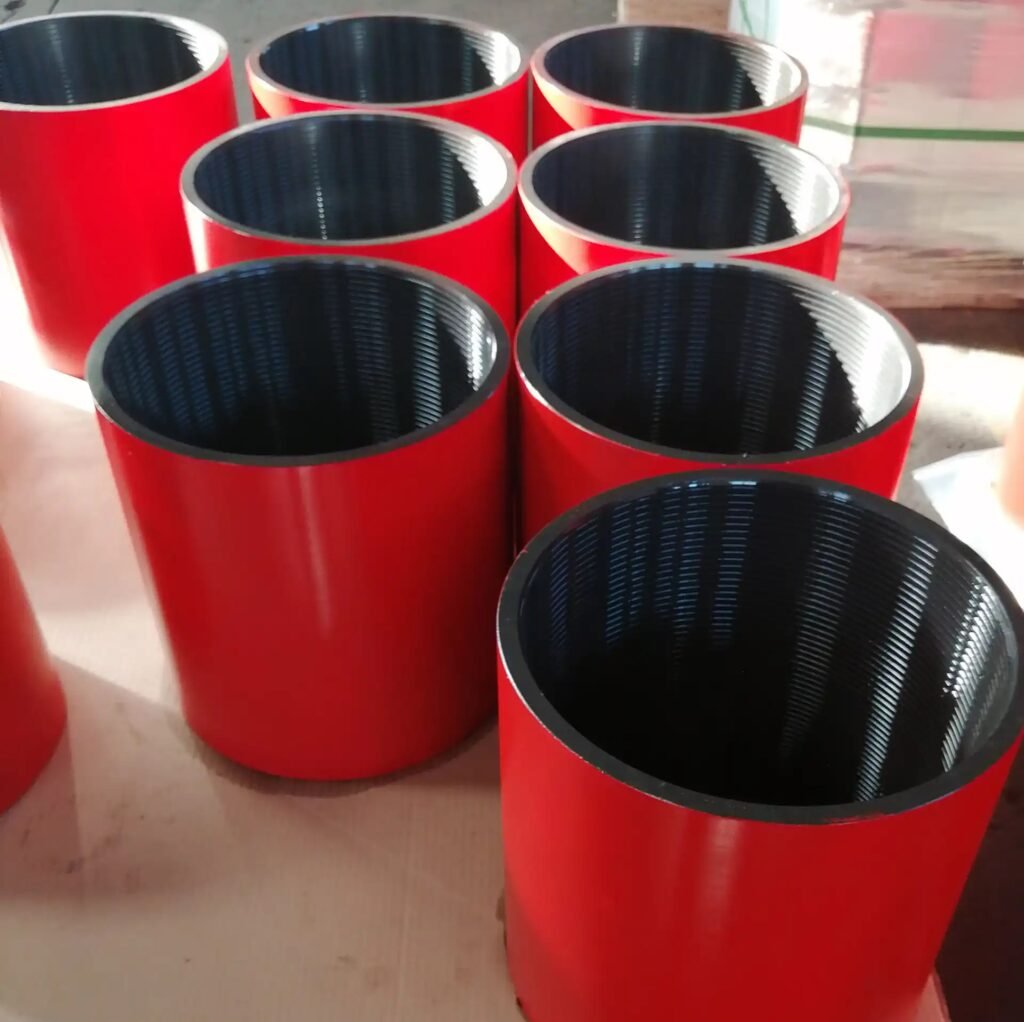
A casing coupling is the short, thick-walled sleeve that joins two joints of casing into one continuous string. Each end carries an internal thread, and each casing joint screws into one side. Without the coupling, there is no casing string — only a rack of loose joints.
The coupling has to be as strong as the pipe it joins. It carries the same tensile load, the same internal pressure, and the same torque as the casing itself, so its grade and thread must match the pipe exactly.
What a Casing Coupling Does
Every casing joint leaves the mill with a pin thread on each end. The coupling, with a box thread on each end, is the piece that turns those joints into a string. It is a simple part, and it is also the part where a wrong size, grade, or thread shows up first — a coupling that does not match the pipe will not make up, or will not hold the load the pipe was designed for.
Sizes and Grades
Casing couplings follow the casing they serve: 4 1/2 inch to 20 inch, in the sizes listed in the API Spec 5CT range. Common grades are H40, J55, N80-1, N80-Q, L80 (including 13Cr), T95, P110, and Q125. The coupling and the pipe should always be the same grade — a lower-grade coupling on a higher-grade pipe becomes the weak point of the whole string.
For tubing, the equivalent piece is the tubing coupling, in the smaller 1.9 inch to 4 1/2 inch range. LP couplings, used on line pipe threads, cover 1 inch to 4 inch to API Spec 5B.
Thread Types: STC, LTC, BTC, and Premium Thread
Most casing couplings are cut with one of three API threads:
- STC (short round thread) — the standard thread for many casing sizes.
- LTC (long round thread) — a longer engagement than STC, used where a stronger joint is needed.
- BTC (buttress thread) — a square-profile thread for higher tensile loads.
Premium thread couplings are also available for gas-tight service, machined to the connection design the buyer specifies. Whatever the thread, both ends of a coupling are the same type — a coupling never mixes two thread forms.
What to Check Before Ordering
A coupling order goes wrong in a few familiar ways. Check these four points before sending an enquiry:
- Size — the casing outside diameter, for example 7 inch or 9 5/8 inch.
- Grade — H40, J55, N80, L80, P110, or the grade on your pipe mill certificate.
- Thread — STC, LTC, BTC, or premium thread, exactly as the pipe ends are cut.
- Quantity — how many couplings the string needs, plus spares.
A coupling that matches on size but not on thread will not make up. A coupling in the wrong grade will not hold the load the pipe was designed for.
What to Send for a Quote
Send the casing size, weight, grade, and thread type, with the quantity. If you have a drawing or a sample connection, send that too — premium thread couplings are machined to the design you specify. Third-party inspection can be arranged on request.
Our couplings are machined in Dagang, Binhai New Area, Tianjin, near Tianjin Port, to API Spec 5CT / 5B. For enquiries, write to info@lxoctg.com or WhatsApp +86 182 2292 5608.