
PTFE Casing Drift Mandrel: Material, Applications and Key Considerations for Oilfield Casing Inspection
A casing drift mandrel is a simple but important tool used in the inspection of oilfield casing. Before casing is put into service, its internal passage needs to meet the required dimensional specifications. A drift mandrel provides a practical way to check this.
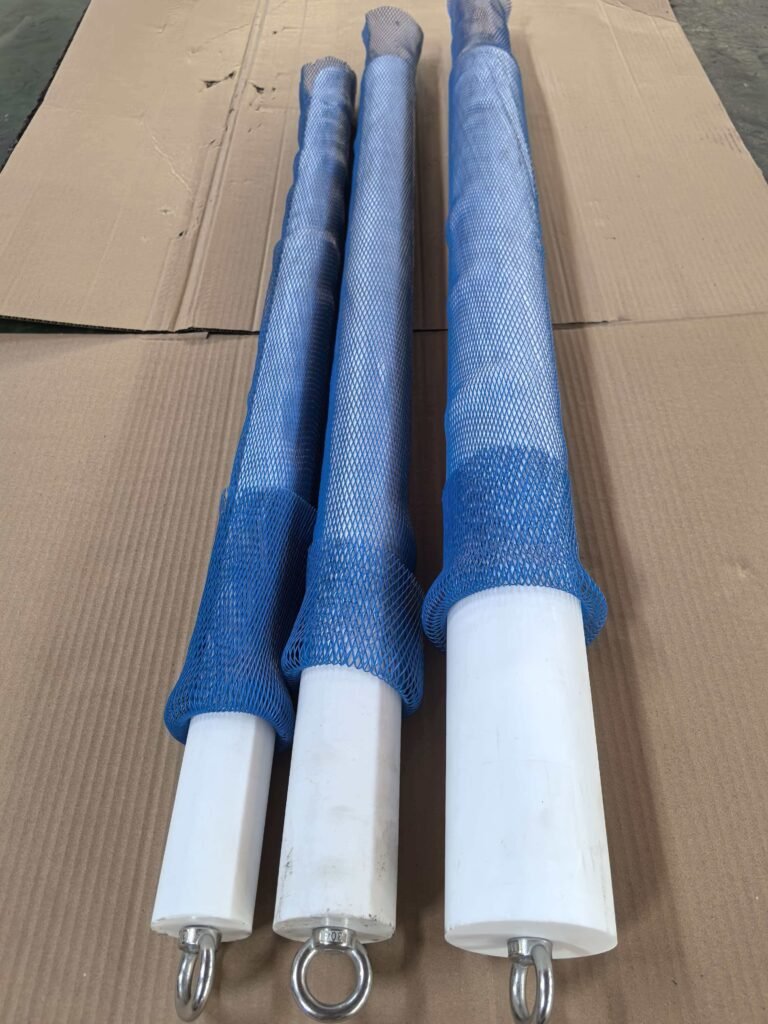
The PTFE casing drift mandrels shown in the picture are designed for this type of inspection. The main body is made from PTFE, with a protective blue mesh sleeve and a metal lifting ring at the bottom.
Although the product has a relatively straightforward structure, its dimensions, material selection, and machining quality all affect how it performs in actual use.
For casing manufacturers, oilfield equipment suppliers, and drilling contractors, choosing the right drift mandrel means more than simply selecting a product of the correct size. The casing specification, drift diameter, applicable standard, and operating conditions all need to be considered.
What Is a Casing Drift Mandrel Used For?
During casing manufacturing and handling, the internal passage of a pipe may be affected by deformation, local dimensional variations, or other problems.
These issues are not always visible from the outside. A casing may appear normal externally while still having a restricted internal passage.
This can become a problem when downhole tools or other equipment need to pass through the casing.
A casing drift mandrel is used to check whether the internal passage meets the specified drift requirements.
The mandrel is passed through the casing over the required length. If it passes through as required, the inspected section meets the applicable drift criteria. If the mandrel cannot pass, the casing and the test conditions need to be examined to determine the cause.
The drift mandrel itself does not measure every aspect of casing quality. Its main purpose is to verify the required internal passage dimensions.
For this reason, the drift diameter and length must be selected according to the casing specification and the applicable inspection requirements.
Why Is Drift Testing Important?
Casing is used in demanding oilfield environments. Once it is installed in a well, correcting an internal passage problem can be difficult and costly.
Checking the casing before use helps identify potential restrictions at an earlier stage.
A properly selected drift mandrel can help with:
- Checking the internal passage of casing.
- Identifying possible local restrictions.
- Confirming compliance with specified drift requirements.
- Supporting casing quality inspection before field use.
- Reducing the risk of problems during subsequent operations.
The actual inspection procedure should follow the applicable standard or the customer’s technical requirements.
Why Choose PTFE for a Casing Drift Mandrel?
PTFE, commonly known as Teflon, is a fluoropolymer known for its chemical resistance and low-friction characteristics.
These properties make it useful in applications where the contact between the tool and the pipe wall needs to be carefully considered.
For a casing drift mandrel, material selection is not just about appearance. The material needs to be suitable for the intended inspection conditions and provide the required dimensional stability and surface characteristics.
Low-Friction Characteristics
When a drift mandrel moves through the casing, the mandrel surface comes into contact with the internal wall of the pipe.
PTFE has a naturally low coefficient of friction compared with many conventional materials. This can help reduce sliding resistance during the drifting operation.
In practical terms, a suitable PTFE mandrel may move more smoothly through the casing, depending on the pipe condition, mandrel dimensions, surface finish, and operating method.
However, friction is only one factor.
A drift mandrel that is incorrectly sized may still become stuck, regardless of the material used. The correct dimensions remain essential.
Surface Contact and Pipe Protection
The internal surface of casing needs to be handled carefully, particularly when the pipe has already been machined or threaded.
A drift mandrel should perform its inspection function without causing unnecessary damage to the pipe wall.
PTFE is relatively soft compared with many metal materials. This makes it a suitable choice for applications where a lower-friction, non-metallic contact surface is preferred.
That said, PTFE should not be treated as a universal replacement for every type of metal drift mandrel.
The appropriate material depends on the inspection requirements, casing condition, and customer specifications.
Chemical Resistance
PTFE offers good resistance to many chemicals and is widely used in industrial applications where chemical stability is required.
This can be useful in oilfield environments where equipment may come into contact with oils, cleaning agents, or other substances.
The actual suitability of PTFE should still be confirmed for the intended operating conditions.
If a customer has specific requirements related to temperature, chemical exposure, or downhole service, those details should be reviewed before production.
Main Components of a PTFE Casing Drift Mandrel
The casing drift mandrels shown in our product picture consist of three main parts.
PTFE Drift Body
The white cylindrical body is the working part of the mandrel.
Its outside diameter determines the size of the internal passage being checked. For this reason, dimensional accuracy is one of the most important requirements during machining.
The drift diameter should be confirmed according to the casing size, wall thickness, applicable standard, or customer drawing.
The body length is also important because different casing specifications may require different drift lengths.
A mandrel intended for one casing specification should not automatically be used for another without checking the dimensions.
Protective Mesh Sleeve
The blue mesh sleeve helps protect the PTFE body during handling, storage, and transportation.
During normal factory operations, tools may be moved several times before they reach the customer. A protective sleeve can help reduce surface contact with other products and minimize the risk of scratches or contamination.
For PTFE products, maintaining the surface condition is particularly important because the outside diameter is directly related to the inspection function.
The sleeve is mainly a protective feature. It does not replace the dimensional requirements of the drift body.
Metal Lifting Ring
The metal ring at the bottom of the mandrel provides a convenient connection point for ropes or other handling equipment.
It makes the product easier to move and use during inspection operations.
The ring and connecting components should be suitable for the intended handling method. For larger drift mandrels, the complete connection structure needs to be considered, not just the PTFE body.
Drift Diameter and Length Must Match the Casing Specification
One common mistake in purchasing is to assume that a larger drift mandrel always provides a better inspection.
That is not how drift testing works.
The mandrel must be manufactured to the required dimensions. An oversized mandrel may not be suitable for the intended casing, while an undersized mandrel may fail to provide the required inspection.
The correct drift diameter depends on the casing specification and the applicable requirements.
For example, casing with the same nominal outside diameter may have different wall thicknesses. The actual internal diameter will therefore be different, and the required drift dimensions may also change.
This is why casing size alone is not always enough to determine the correct mandrel.
Before machining, we recommend confirming the following information:
- Casing nominal outside diameter.
- Wall thickness.
- Steel grade, where relevant.
- Required drift diameter.
- Required drift length.
- Applicable standard.
- Customer drawing or technical specification.
Once these details have been confirmed, the mandrel can be manufactured to the required dimensions.
How Is a Casing Drift Mandrel Used?
Drift testing is commonly carried out during casing inspection or before the casing is put into service.
The mandrel is passed through the casing over the specified length. Depending on the application, this may be done using a rope or other suitable handling equipment.
If the mandrel cannot pass through a particular section, the operation should be stopped and the cause investigated.
Possible reasons include:
- Local deformation of the casing.
- A restricted internal diameter.
- Foreign material inside the pipe.
- Incorrect mandrel dimensions.
- A mismatch between the mandrel and casing specification.
The inspection procedure should be carried out under the conditions required by the applicable standard.
The casing should be properly supported, and the internal passage should be free from foreign material that could affect the result.
Correct handling is also important. The mandrel should not be forced through the casing when resistance is encountered.
A failed drift test does not automatically identify the exact cause of the problem. Further inspection may be needed.
What Should Buyers Confirm Before Ordering?
For customers purchasing PTFE casing drift mandrels, the most important step is to confirm the technical requirements before production.
A few basic details can help avoid misunderstandings.
Casing Size
Specify the casing size for which the mandrel will be used.
Common sizes include 4½”, 5½”, 7″, 9⅝”, and 13⅜”, among others.
Drift Diameter
This is a critical dimension.
The diameter should be based on the required inspection specification rather than simply the nominal casing size.
Drift Length
The required length should also be confirmed.
Different casing sizes and applicable standards may have different requirements.
Material
Confirm whether the main body is manufactured from PTFE or another material.
If the customer has a specific material grade or technical requirement, this should be included in the order.
Surface and Machining Quality
The drift body should be checked for obvious scratches, cracks, deformation, or other defects.
Dimensional accuracy is particularly important because the product is used for internal passage inspection.
Customer Drawings and Standards
If the product is required to comply with API 5CT, ISO, or a customer-specific specification, the applicable requirements should be confirmed before machining.
For non-standard sizes, a customer drawing is often the best way to avoid dimensional misunderstandings.
Manufacturing PTFE Casing Drift Mandrels for Oilfield Applications
At our factory, we understand that a casing drift mandrel is not simply a plastic cylinder with a lifting ring.
It is an inspection tool, and its dimensions and material need to match the intended application.
The quality of the final product depends on several factors:
- Correct material selection.
- Accurate machining.
- Proper control of the drift diameter.
- Suitable body length.
- Good surface condition.
- Reliable connection components.
- Clear confirmation of customer requirements.
These details are important whether the product is being used by a casing manufacturer, an oilfield equipment supplier, or a contractor carrying out field operations.
We manufacture oilfield tubular products, casing accessories, and threaded products. We also provide PTFE casing drift mandrels according to customer specifications and drawings.
Our focus is on producing products that meet the customer’s actual requirements, rather than simply supplying a product based on a general description.
Conclusion
PTFE casing drift mandrels are used to check the internal passage of oilfield casing against specified drift requirements.
Their relatively simple structure does not mean that the manufacturing requirements are unimportant.
Material selection, drift diameter, body length, surface condition, and connection design all contribute to the suitability of the product.
PTFE is a useful material for applications where low friction, chemical resistance, and a non-metallic contact surface are preferred.
However, the correct mandrel dimensions remain the most important consideration.
Before placing an order, customers should confirm the casing specification, required drift dimensions, applicable standard, and any special technical requirements.
If you are looking for a PTFE casing drift mandrel for your oilfield casing inspection, we can review your requirements and manufacture the product according to your specifications.
Please send us your casing size, drift diameter, technical drawing, or other relevant details. Our team will be happy to discuss the suitable product and machining requirements.
我比较推荐这个: